TradingKey - Over the past week, the memory chip sector once again became the focus of U.S. stocks. On August 13 Eastern Time, SanDisk (SNDK) delivered long-term positive news at its Investor Day, sending its stock surging 13.67% that day; SK Hynix ADR (SKHY) rose 7.3%, while Micron Technology (MU), Western Digital (WDC), and Seagate (STX) all followed suit with gains.
In terms of weekly gains, the rally was even more impressive. Over the past week (August 10 to 14), SanDisk gained 35.38% cumulatively, SK Hynix ADR rose 20.61%, and Micron Technology climbed 10.72%. The memory sector's overall performance far outperformed the broader market, while the Nasdaq rose a mere 0.14% over the same period.
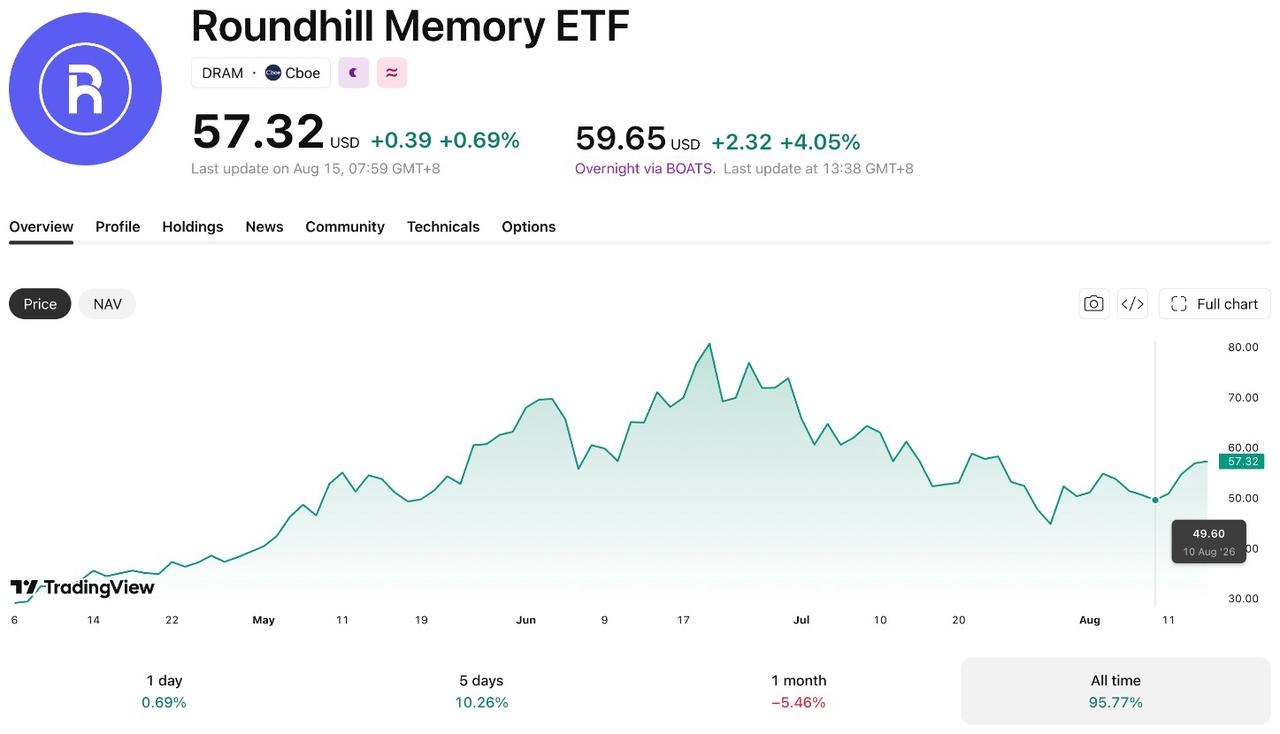
Roundhill Memory ETF (DRAM) has rebounded about 30% from its July 24 low, and enthusiasm for the memory market is running high. But for investors, is it still worth chasing the rally in an ETF launched just in April?
[Source: TradingView]
What Is a DRAM ETF?
On April 2, 2026, Roundhill Investments launched the world's first pure-play memory-themed ETF, filling a gap in the chip subsector. Unlike broad semiconductor ETFs, the DRAM ETF sets stringent stock selection criteria: a company's memory business revenue must exceed 50%, thereby avoiding the dilution of holding purity from non-core businesses such as chip design and equipment manufacturing. The product adopts an active management strategy with an expense ratio of 0.65% and rebalances quarterly.
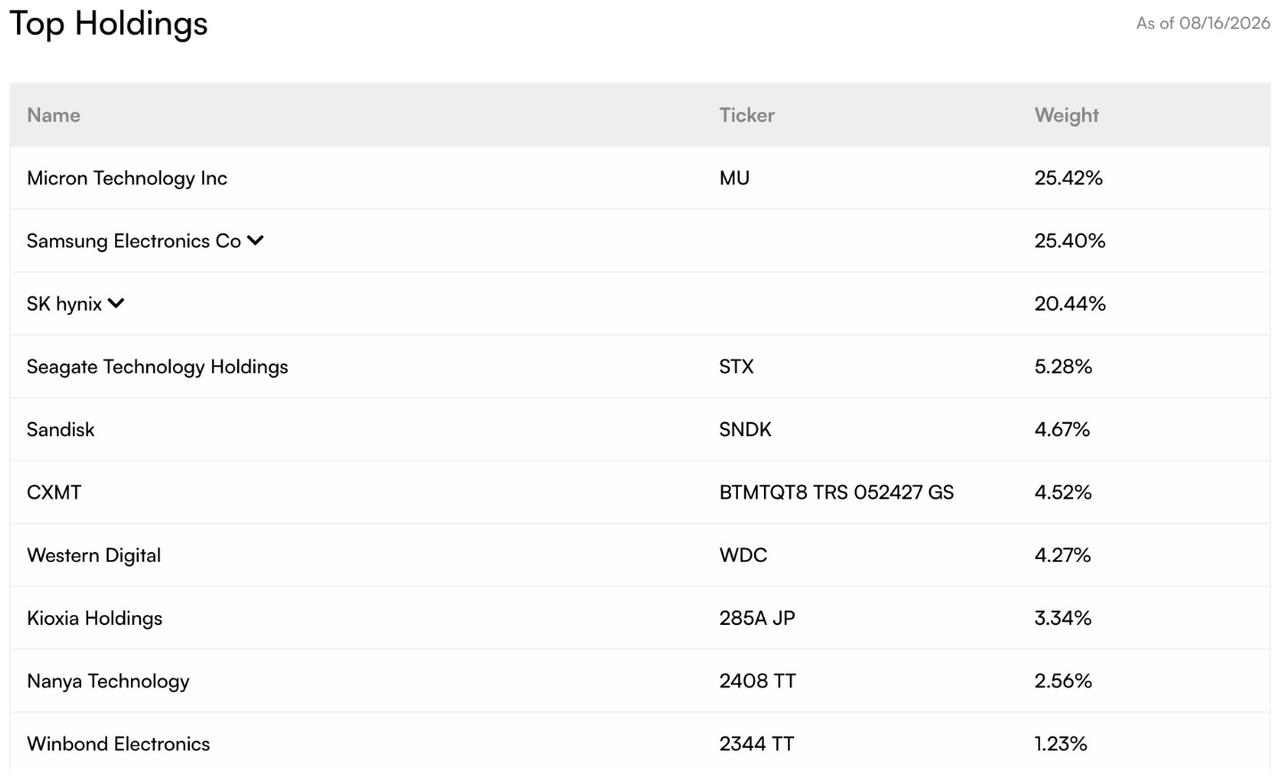
The ETF's holdings are highly concentrated. As of August 16, 2026, the top three holdings—Micron Technology (25.42%), Samsung Electronics (25.4%), and SK Hynix (20.44%)—collectively accounted for over 70%. The remaining constituents are Seagate, SanDisk, CXMT, Western Digital, Kioxia, Nanya Technology, and Winbond Electronics, in that order.
[Source: Roundhill Investments]
What Are the Factors Supporting the DRAM Rise?
The foundation of this rally is a genuine supply-demand gap, rather than thematic speculation. Micron CEO Sanjay Mehrotra publicly stated that the company can currently meet only 50% to two-thirds of the demand from certain key customers, calling it "the largest supply-demand gap in history."
Prices provide the most direct confirmation of this supply-demand gap. Spot prices for DDR5 (16Gb) surged over 4x from November 2025 to the end of June 2026; according to TrendForce data, contract prices for standard DRAM jumped 93% to 98% quarter-on-quarter in the first quarter of 2026 and continued to rise 53% to 58% in the second quarter.
More crucially, a single HBM die consumes 3 to 4 times as many wafer resources as standard DDR5, continuously squeezing capacity for general-purpose DRAM.
Some manufacturers have provided extremely optimistic earnings projections. SanDisk noted at its Investor Day that it expects its non-GAAP gross margin to remain at around 80% for fiscal years 2028 through 2030. In addition, the company explicitly stated that after completing business investments over the next three years, it will return 100% of its remaining cash to shareholders.
In terms of valuation, SanDisk's current price-to-earnings ratio stands at about 19.51x, which seems modest. However, behind this low P/E is earnings growth that far outpaces stock price gains. Micron's revenue jumped 345.7% year-over-year in the third quarter of fiscal 2026, while SanDisk's fourth-quarter revenue grew 372% year-over-year. When earnings expand at such a pace, trailing P/E ratios systematically lag behind fundamentals.
What Are the Notable Risks of DRAM ETFs?
Concentration is the primary risk. As of August 16, 2026, the top three holdings of the DRAM ETF were Samsung Electronics, Micron, and SK Hynix, together accounting for over 70%. Once the memory thesis reverses, NAV drawdowns will be equally severe. Furthermore, Samsung and SK Hynix combined account for nearly half of the weighting, exposing the fund to South Korean won currency risk.
Divergence in cycle expectations also cannot be ignored. Goldman Sachs (GS) projects tight supply and demand to persist through 2028, while BOCOM International estimates it to last at least until the fourth quarter of 2027; however, Morgan Stanley (MS) expects year-over-year growth in DRAM contract prices to peak in the fourth quarter of 2026. A peak in growth rate does not equate to price drops, but the market typically prices in changing expectations in advance.
In addition, ETF volatility itself is a factor that cannot be ignored. After reaching $81.34 on June 22, the ETF suffered a maximum drawdown of nearly 35% by late July. Rebalancing by the management team in early August also sent a cautious signal: while adding ChangXin Technologies, it reduced its position in Samsung Electronics by about 3 million shares over three consecutive trading days, cashing out approximately $432 million.
Should You Buy DRAM ETFs Now?
For tactical investors who are familiar with the rhythm of the memory industry and can tolerate high volatility, the DRAM ETF remains a preferred high-beta choice. The core logic is that AI capacity crowding is structural, and capacity being sold out through 2027 provides an earnings floor. A safer approach is to build positions in tranches rather than chasing all at once. In addition, Micron's Q4 FY2026 earnings release is imminent, and whether its results meet expectations will directly impact its short-term direction.
For investors seeking long-term, stable allocations, now may not necessarily be the best entry point. The ETF has rebounded about 30% from its July low, with short-term catalysts already partially priced in by the market; Morgan Stanley's warning of growth peaking coexists with Goldman Sachs' bullish outlook for 2028, indicating that significant volatility lies ahead.
The medium- to long-term thesis for the memory supercycle is highly likely intact, but between 'the cycle is not over' and 'buying right now makes sense' lies the matter of entry price. The DRAM ETF is essentially a tool whose value largely depends on the user's timing and risk tolerance.
Find out more