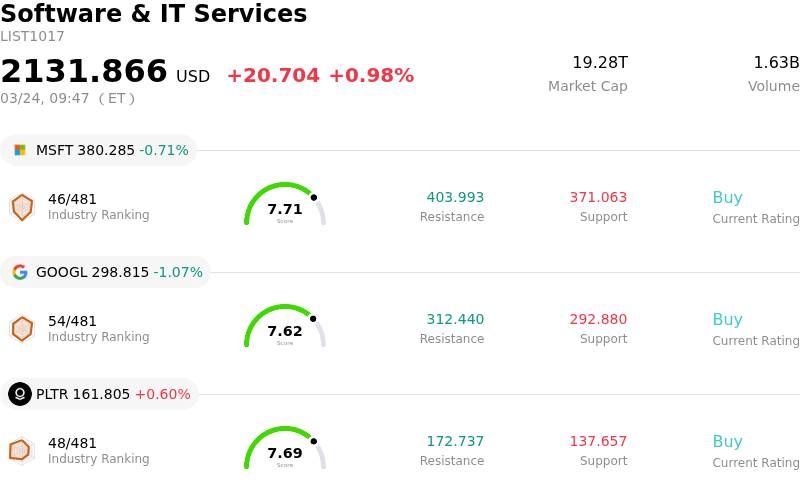
SAP SE (SAP) opened down by 3.36%. The Software & IT Services sector is up by 0.98%. The company underperformed the industry. Top 3 stocks by turnover in the sector: Microsoft Corp (MSFT) down 0.71%; Alphabet Inc Class A (GOOGL) down 1.07%; Palantir Technologies Inc (PLTR) up 0.60%.
What is driving SAP SE (SAP)’s stock price down today?
SAP's stock experienced a decline today, marked by significant intraday volatility, primarily driven by a notable adjustment in analyst sentiment. JPMorgan downgraded SAP from an "Overweight" to a "Neutral" rating. This change in rating was accompanied by a substantial reduction in the price target and the removal of SAP from the firm's "Analyst Focus List."
The primary rationale behind JPMorgan's revised outlook centers on concerns regarding the deceleration of SAP's Current Cloud Backlog (CCB) growth, a trend analysts anticipate will persist. The financial institution's previous bullish stance was predicated on expectations of accelerating revenue growth and significant margin expansion, but the current assessment suggests a shift in this performance outlook. Additionally, analysts highlighted potential headwinds arising from SAP's ongoing business model transformation, which could introduce greater earnings volatility, and an increasingly competitive landscape necessitating higher investment. Lowered earnings expectations for the period spanning 2026 to 2028, reflecting a slower pace of anticipated margin expansion, also contributed to the downgrade.
This development impacted SAP's shares, with the stock trading at its lowest point since January 2024. While SAP recently reported stronger-than-expected earnings, beating consensus for both EPS and revenue in its latest quarter, the forward-looking concerns raised by the analyst downgrade appear to have outweighed recent positive financial performance.
Broader industry dynamics also play a role in the prevailing market sentiment for enterprise software companies. The enterprise AI market continues to grow, and SAP itself is heavily focused on integrating AI into its offerings and driving cloud migrations, particularly with S/4HANA. However, some reports indicate that SAP is behind on its cloud migration targets. The broader macroeconomic environment has presented mixed signals, with some US economic indicators showing weakness and major US equity indices experiencing a consecutive weekly decline. Despite this, optimism surrounding artificial intelligence remains a strong theme within the tech sector.
Technical Analysis of SAP SE (SAP)
Technically, SAP SE (SAP) shows a MACD (12,26,9) value of [-6.37], indicating a sell signal. The RSI at 31.13 suggests neutral condition and the Williams %R at -86.81 suggests oversold condition. Please monitor closely.
Fundamental Analysis of SAP SE (SAP)
SAP SE (SAP) is in the Software & IT Services industry. Its latest annual revenue is $41.49B, ranking 14 in the industry. The net profit is $8.07B, ranking 13 in the industry. Company Profile
Over the past month, multiple analysts have rated the company as Buy, with an average price target of $300.92, a high of $367.98, and a low of $178.44.
More details about SAP SE (SAP)
Company Specific Risks:
- SAP's cloud migration plan is significantly behind target, falling short by an estimated €2 billion or 24% of its goal, indicating slower-than-anticipated customer transition from on-premise software to cloud subscriptions and posing a direct threat to long-term financial objectives.
- The company is currently under an EU antitrust investigation concerning its ERP support practices, which introduces risks of regulatory fines, legal costs, and potential mandatory changes to business operations.
- Security vulnerabilities were identified in key SAP components during the March 2026 Security Patch Day, contributing to operational risks.
- Investor apprehension persists following disappointing Q4 2025 earnings, where cloud backlog growth was below analyst expectations and the 2026 cloud revenue forecast disappointed the market, leading to concerns about future financial performance and continued stock pressure.
Find out more