


Hello, Tigers!
In the previous lesson, I introduced you to a new term: "anomaly," and explained to you the investment opportunities presented by two types of financial report anomalies. In today's lesson, we will continue to discuss a common term: "panic," and I will teach you three ways markets react during stock market panic.
How panic arises
How does panic in stock market trading occur? Based on what we've discussed in previous lessons, we can roughly summarize it into four reasons:
(1) Herd Mentality
Investors are often influenced by other investors, leading to a herd effect. When sudden events or significant price fluctuations occur in the market, they may join the majority out of fear of missing out or fear of loss, resulting in excessive buying or selling, which can trigger stock market panic.
(2) Loss Aversion
People are more sensitive to losses than gains, a phenomenon known as loss aversion. In the stock market, when investors perceive losses, they may panic and overreact, eager to minimize losses, resulting in massive sell-offs and worsening stock market panic.
(3) Overconfidence
Investors often overestimate their judgment and analytical abilities, leading to an overreliance on their own views. When uncertainty or negative news arises in the market, investors may overly trust their views, ignoring other possible factors, thereby causing excessive stock market panic.
(4) Mental Accounting Effect
Investors often divide their investments into different "accounts," such as retirement accounts or children's education accounts. When one account incurs losses, investors may feel anxious and panic, leading them to engage in excessive behavior in other accounts to compensate for the losses.
In summary, investors may exhibit irrational and emotion-driven behaviors in stock trading, which in specific contexts may lead to stock market panic and the emergence of panic stock situations that are driven more by emotion than fundamentals.
So how can you overcome the fear of stock market panic and prevent trading from distorting? Remember these three methods:
First Method: Learn to Rationally Diversify Your Investment Portfolio
As rational investors, we should be very clear about our risk preferences, and risk preferences are not easily changed.
So, how should rational diversification of investments be done?
In fact, rational diversification of investments or optimal capital allocation ratios can be accurately measured. Each person's optimal capital allocation should maximize their utility, and utility depends on three variables: asset returns, asset risks, and one's risk preferences.
In other words, faced with the same assets, the optimal capital allocation ratio for each person depends on their risk preferences, and we need to calculate the most suitable allocation ratio based on our own risk preferences.
For example:
Investor A is more averse to risk, so A's optimal capital allocation may be calculated as 60% of funds invested in bonds and 40% invested in stocks; while Investor B is less averse to risk, so B's optimal capital allocation may be calculated as 40% of funds invested in bonds and 60% invested in stocks.
Because A and B have different risk preferences, their capital allocations are also different. Everyone has a definite risk preference, so the optimal capital allocation is determined for each person.
During times of stock market panic, such rational diversification becomes crucial, as it can help investors maintain balance, avoid emotional decision-making, and prepare for recovery when market stability returns.
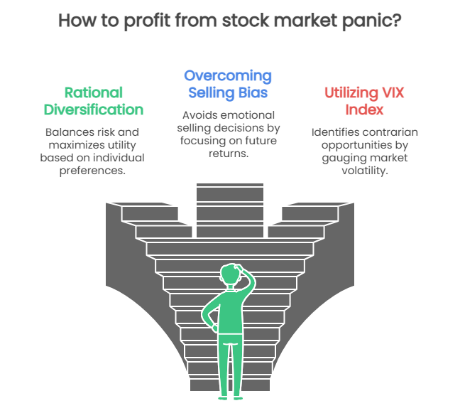
Second Method: Overcoming Incorrect Selling Behavior Bias
We've discussed in previous lessons that in the selling process, it's easy to generate selling behavior bias due to panic, with the most common behavior being the "disposition effect."
This was proposed by behavioral economists Hersh Shefrin and his collaborator Meir Statman in 1985, referring to investors' reluctance to sell assets at prices lower than their purchase costs, meaning investors tend to realize gains while delaying the realization of losses.
So, as rational investors, how should we deal with this situation?
First, you should understand that the disposition effect is a decision-making error. The disposition effect is essentially caused by decision reference points. Because there are reference points, people tend to make decisions unconsciously in the perceived areas of gains and losses. And people have different risk preferences in the areas of gains and losses, which leads to the prematurely lock in gains while continuing to hold losing positions.
Since selling winners and holding losers is incorrect, is it okay to choose to sell losing stocks next time?
If your answer is yes, then you're wrong again.
In fact, selling based solely on whether an investment is currently profitable or unprofitable is incorrect. Investment should "look forward," not "look back." A more rational approach does not look back; selling behavior should be unrelated to cost reference points and corresponding gains or losses, but should look toward the future.
Therefore, when considering whether to sell a stock, it may be useful to take into account its expected future return. However, all investment decisions involve risk, and past performance is not indicative of future results.
This mindset is particularly important during stock market panic, when panic selling and emotional reactions dominate. Avoiding behavior bias helps investors identify true opportunities rather than reacting impulsively.
Third Method: Learn to Utilize the VIX Panic Index for Contrarian Trading
The VIX panic index, whose full name is the Volatility Index, was created by the Chicago Board Options Exchange (CBOE) in 1993. The VIX panic index measures market participants' expectations of volatility for the S&P 500 Index.[1]
In simple terms:
The higher the value of the VIX index, the greater the expected volatility of market participants, indicating higher market risk; the lower the value of the VIX index, the lower the expected volatility of market participants, indicating relatively calm markets.
Therefore, generally speaking, when the level of the VIX index is low, it represents a relatively stable market, and we can consider buying stocks on dips. When the level of the VIX index is high, it may represent market instability, and conservative strategies, reducing positions, or holding safe-haven assets can be considered.
The VIX index is often called the “fear gauge” of stock market panic. By observing its changes, investors can detect when panic peaks and when confidence begins to recover, identifying potential contrarian opportunities.
So, those are the three methods to profit from stock market panic. Have you learned them? If you want to apply what you’ve learned and seize opportunities during stock market panic, you can explore smarter investing tools and insights on Tiger Trade.
In the next lesson, we will explore three common behavioral finance patterns and their potential impact on long-term returns.
Reference
[1] Available at: https://cdn.cboe.com/resources/vix_options/VIX_fact_sheet.pdf
Disclaimer: Investing involves risks. This content does not constitute financial advice. It should not be interpreted as an offer, recommendation, or solicitation to buy or sell any financial products. Any related discussions, comments, or posts by the author or other users should not be seen as such. The information provided is for general informational purposes only and does not take into account your individual investment goals, financial circumstances, or needs. Tiger Brokers makes no guarantees regarding the accuracy or completeness of the information. Investors are encouraged to conduct their own research and consult a professional advisor before making any investment decisions. This advertisement has not been reviewed by the Monetary Authority of Singapore.